How business process modelling can prepare you for digital transformation
Most people picture AI and machine learning when they think of ‘digital transformation’. While these initiatives do have exceptional promise for many...
3 min read

Process historians have been used to monitor processes in the industrial sector for more than 20 years, and yet many companies Nukon talks to don’t have them.
So what do process historians do and why is it worth the investment? We recap the basics and outline why process historians are essential for any kind of data analysis.
Process historians are a specialised type of non-relational Structure Query Language (SQL) database that stores, processes and analyses time-stamped industrial data. Their capability to map data points over time makes them critical in analysis and decision-making for a range of industries and disciplines from utilities, energy, manufacturing and process engineering.
Sort of. A process historian is essentially a type of ‘time-series database’ that’s heavily tailored for the process control industry. Time-series databases are used in other industries such as finance (stock prices over time) or IT (server use over time). This space has been revolutionised by tech giants like Google, Facebook and Amazon. They’ve developed their own powerful NoSQL databases to analyse millions of data points for millions of internet users in real-time.
The options are limitless. Data items (or tags) that can be stored and processed could be:
These can all be mapped across any given historical time span and in real-time.
By collecting this information, operations managers can produce models or identify patterns to pinpoint problems and improve future processes.
All the data in the world is useless without the ability to analyse it.
It’s shocking but true: many businesses still use paper to log their data. This could be via trends in a SCADA system or simply using Excel to track data over time. Historians have far greater capability to do complex analyses of data sets over time. For example, picking up patterns that lead to failure events. Operations managers and CIOs may be able to find this information from spreadsheets, but only after a failure event. Historians can pick up patterns, anomalies and even be taught to look for these signals to alert production managers of events before they happen. This type of pattern analysis is providing the foundations for machine learning. For now, though, it can help reduce error and increase overall quality in manufacturing.
Internet of Things (IoT) technologies are presenting businesses with opportunities to improve performance, reduce error and impact the bottom line. But these advancements mean industrial plants will soon be faced with an overwhelming amount of data – and it will go to waste if the system can’t store, process and turn it into valuable insights. This is why a powerful database is essential for any business going forward.
Time-series databases are the fastest-growing segment of the database industry over the past two years, with an expanding list of options available on the market.
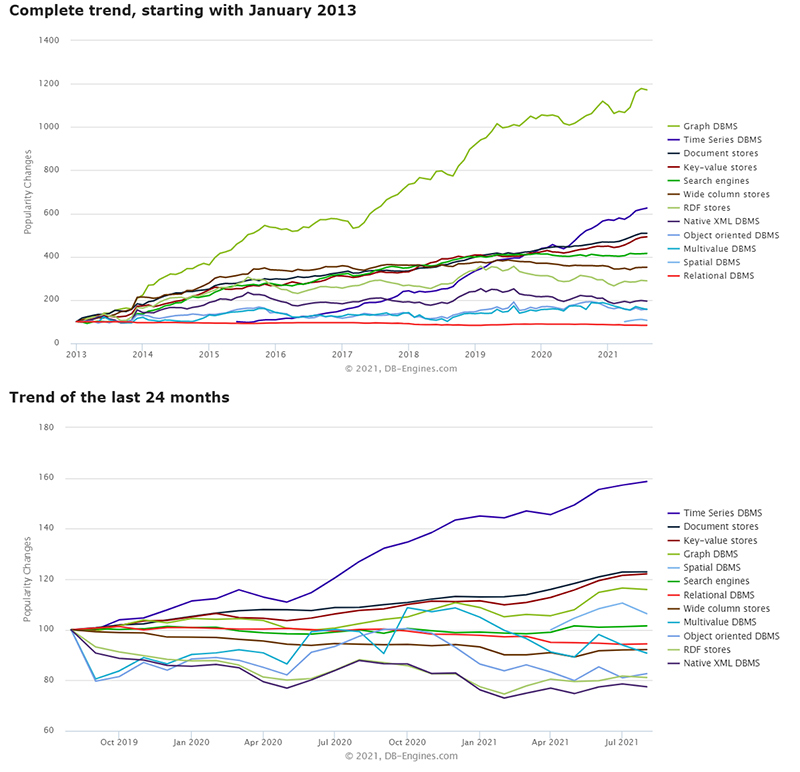
There are several established enterprise data historians, including Aspentech IP21, OSISoft PI Wonderware InSQL and GE Proficy.
The open-source data historians available now have the scalability and processing power of Google technology behind them; Influx, Grefana, and Elasticsearch are a few. We’ll weigh up the pros and cons of enterprise process historians and open-source time-series in a future blog post.
The ability to collect and analyse production data is a distinguishing factor of competitive manufacturers. Tech giants of the internet have revolutionised this space building time-series technology that is user-friendly, powerful, and a world apart from the traditional data historians of the past 40 years.
Harnessing these technologies will dictate how companies set themselves apart as IoT technologies are adopted.
Catch up on database technologies for industrial operators in our other blog posts and case studies:
1. How Google gave rise to time-series databases
2. Data historians vs time-series: which is better for data analysis?
3. How TasWater reduced data costs with Nukon's time-series configuration sync tool
The first step towards powerful data analysis is in having it all in one place. Obtaining this 'single source of truth' may seem as likely as spotting a unicorn, but it is possible. Data warehousing is a topic we'll be exploring in a future blog post, a dimensional modelling solution to achieving this single source of truth.

Most people picture AI and machine learning when they think of ‘digital transformation’. While these initiatives do have exceptional promise for many...
 Alec Konynenburg : October 11, 2016
It seems that a new technology fad is entering the market every week. No industry is immune to it, but in technology and manufacturing spheres, the...

Alec Konynenburg : November 29, 2016
The Australian manufacturing industry is in a state of flux. We are competing with countries that can offer consumers more value for less money. So...